
I talked to Randy Stark about downwind jibing while we were packing up the Moths at the end of the E-city Nationals. The Nationals was a windy regatta and the downwind legs took their toll, especially of new Moth sailors like Randy. Jibe, capsize.....jibe, capsize or in the case of Fricke Martschink, nosedive....capsize were doing in many Mothies that weekend. Singlehanders are never easy to jibe in a breeze. The Moth with it’s long overhanging boom is difficult even when compared to other singlehanders. I managed to survive every jibe that weekend, some not so pretty, by drawing on several years of Laser experience and a technique honed in that class called the S-curve jibe. I asked Randy if he had heard of the S-curve jibe and he said no, he hadn’t. I spent the next 5 minutes giving him a brief explanation, carving the turns in the air with my hands.
When I got home, I figured I could find an article or section in my sailing library on S-curve jibes that I could photocopy and send off to Randy. Paul Elvstrom’s book had a paragraph but, in none of my other books was there a mention of the S-curve jibe. I even browsed a copy of Dick Tillman’s “Laser Sailing” at the local marine chandlery and didn’t see the S-curve technique mentioned. I didn’t realize that this technique was so obscure! Time to put my technique into words.
The S-curve becomes necessary in a breeze because the normal light/moderate air jibe technique doesn’t work. In a nutshell, the boom that so gracefully flicks over in a light air jibe is now plastered onto the leeward shroud and it really doesn’t want to come over. Trying to physically pull the boom over to initiate the jibe doesn’t work. The main quickly loads up, the Moth simultaneously rolls to leeward and heads upwind, the boom sticks in the water, weather helm instantly renders the rudder useless and SPLAT!, capsize to leeward. And we haven’t even got to the jibing part yet!
To get the boom to come over we have to initiate the jibe by oversteering, radically sailing by the lee to get the breeze on the leeward side. With the aid of the wind and maybe a timely pull, the main will pop over. But a new problem arises when the boom finally careens over; we are no longer pointed downwind but at a angle more perpendicular to the wind. The centrifugal force of the boom whipping across combined with the Moth pointing further upwind results in the same situation as before. The Moth simultaneously rolls to leeward and heads upwind, the boom sticks in the water, weather helm instantly renders the rudder useless and SPLAT!, capsize to leeward.
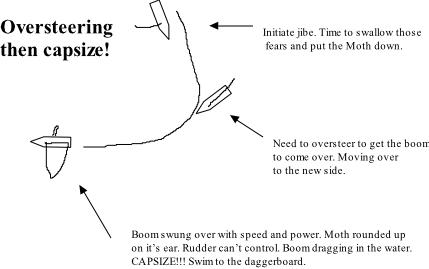
The S-curve jibe adds a downwind turn just as the boom is zipping over to blunt the centrifugal force of the boom zinging across.
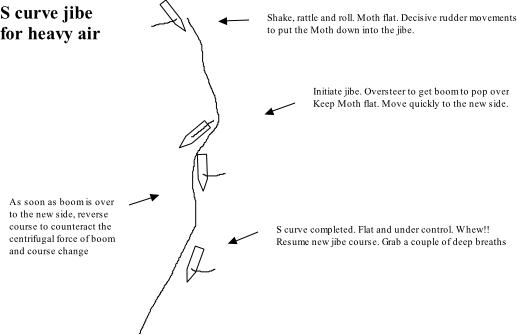
The amount of downwind course correction is tricky. Too little, and you still roll into leeward, too much and you roll into windward. When to begin the course correction is tricky. Coordinating the course correction at the same time you are changing sides is tricky. So practice, practice, practice. Learn the S-curve jibe in moderate airs and then try it again and again in a breeze. But if you are a weekend warrior, expect to get it wrong every once in a while like I did last summer in front of my home club. Ahhh! the Chesapeake mark of a capsize, that black muddy sail head.