
The skin has been turned over and the transom fitted. Note that the cross brace remains to hold the shape. Vertical struts are added at the cross braces to keep the hull skin from twisting while work is in progress. The bottom seam is reinforced with epoxy on the inside at this time.
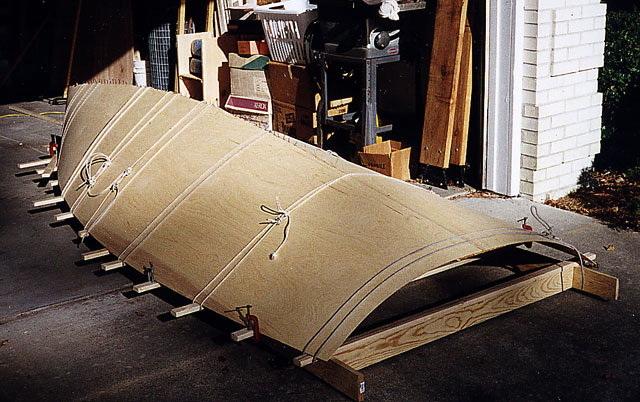
The skins have been joined with wire along the keel and up the stem, but not perminently glued yet. The developed shape is then adjusted by tweaking the keep joint and sheer. Then, add the molding along the sheer for reinforcement, and add several transverse braces in spaces between the crosspieces to stabilize the shape before turning her over. Run Epoxy along the keel and stem before turning also.
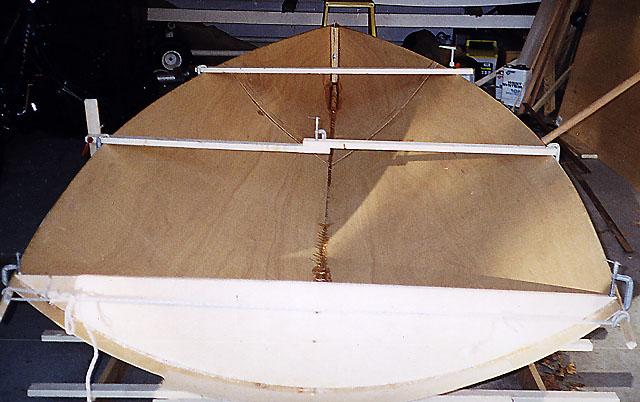
The skin has been turned over and the transom fitted. Note that the cross brace remains to hold the shape. Vertical struts are added at the cross braces to keep the hull skin from twisting while work is in progress. The bottom seam is reinforced with epoxy on the inside at this time.
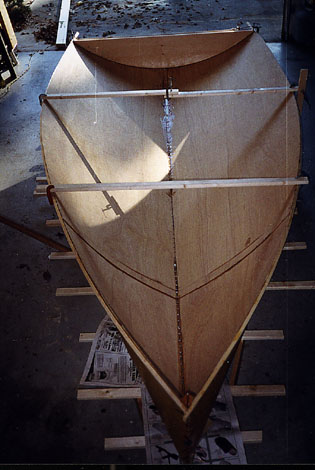
Another view at the same stage as photo #3. The butt straps are clearly visible (scarfing is not necessary if a good butt joint is glued while the skins are still flat). The stem piece has been put in including the headstay fitting. The molding along the sheer can be seen from this view.
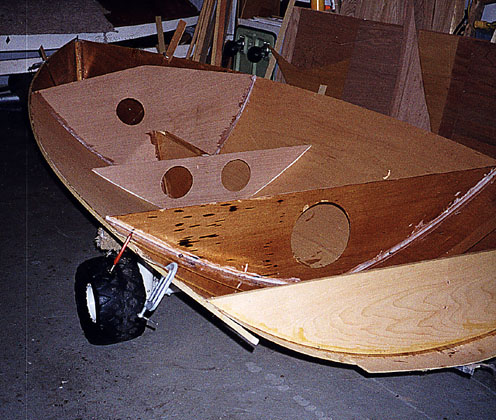
The bulkheads and well have been installed. Internal surfaces coated with epoxy and 2" wide ribs added fore and aft to provide proper stiffness.
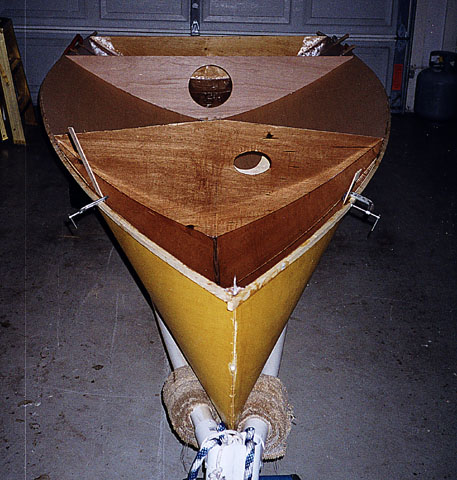
Approximately the same stage of construction as photo #5. All internal surfaces receive a coat of epoxy now since the deck sections will not allow sufficient access to them later. The cockpit area has not been done yet because the ply will be doubled in the foot area next.
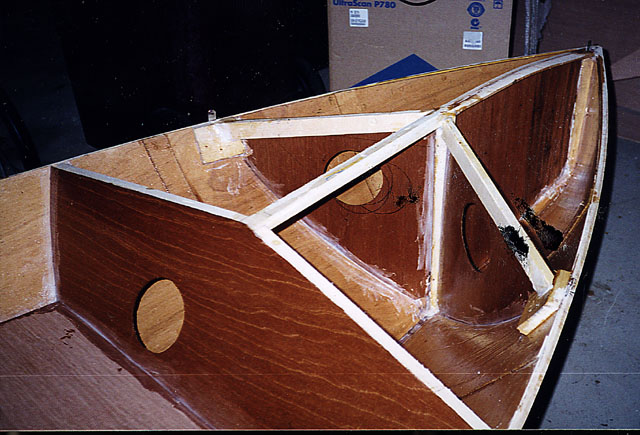
The remaining internal bow structure has been added. This includes bulkheads that run from the mast support post to each stay location. The mounting blocks and stay tangs are installed. 1x1 stock is added at the upper edge of each piece to provide a surface to glue the deck down and ensure the bulkheads can handle the compression loads. The platform around the well can also be seen.